PROCESSING...

Anti-Money Laundering
Consulting Services & Strategies

0 Items - Total: $0.00 CAD

Suspicious Transaction Reporting in 2015

Preparing for a FINTRAC examination

At the Canadian Institute’s 14th Annual AML Forum, the Financial Transactions and Reports Analysis Centre of Canada (FINTRAC) reviewed its expectations for suspicious transaction reporting. FINTRAC emphasized that suspicious transaction reports (STRs) are vital to the agency’s mandate as Canada’s financial intelligence unit (FIU) and ongoing collaboration with law enforcement agencies. While reporting entities (REs) in Canada have been required to report transactions for quite a few years, we’ve had many questions from REs about what FINTRAC expects and looks for in examinations. FINTRAC’s most recent guidance is useful in tuning your technology, enhancing your processes, and asking the right questions at industry association meetings.

What is FINTRAC Looking for in STRs?

When FINTRAC conducts compliance examinations, they will be applying three tests to STR data, including:

  1. Entity Practitioner: FINTRAC will look for transactions that are similar to those involved in STRs that you have reported. If there are similar transactions or transaction patterns that have not been reported to FINTRAC, there should be an explanation for the difference. Where possible, this explanation should be documented.
  2. Sector Practitioner: FINTRAC will compare the number and type of STRs submitted by similar entities. The size and type of business are taken into consideration.
  3. Reasonable Practitioner: FINTRAC will analyze a sample of reported STRs and unreported transactions against relevant guidance. In this case, relevant guidance means the suspicious transaction indicators from FINTRAC’s Guideline 2 that are applicable to your business.

These are terms that we’re likely to hear more about over the coming months, and there are compliance program adjustments (most of them relatively simple) that can be made to ensure that you’re meeting this standard.

Tune Your Technology

Amber looking at laptop FINTRAC screen

Most REs use software solutions to detect potentially suspicious transactions. Almost all transaction monitoring software uses some type of rules-based system to determine when alerts should be generated. These rules should, at minimum, reflect the indicators that are applicable to your business. Not all of the indicators from FINTRAC’s Guideline 2 will be applicable to your business. Where possible, you should document the decisions that you make about your transaction monitoring rules, including the rationale for those decisions.

The most sophisticated software platforms have machine learning functions. These can take the decisions that have been made about previous alerts and use this information to refine how the program works. For example, if a particular pattern of transactions was deemed to be suspicious, the program may look for similar patterns.

If you’re not using software that does this on its own, don’t panic. You can review the STRs that you’ve submitted to FINTRAC to determine whether your transaction monitoring rules are tuned to reflect the types of money laundering and terrorist financing threats that you’ve previously encountered. This should be done on a regular basis (for example, as part of your Risk Assessment updates). If you have an STR that is related to a pattern that you don’t have a rule to cover, you may want to do this sooner, rather than waiting for the next scheduled update.

Train Your Staff

Training

Over the years, I’ve heard many Compliance Officers express frustration about not knowing whether or not STR data has been useful to FINTRAC or law enforcement. To close this gap, I’ve looked for articles and speakers from FINTRAC and law enforcement that could provide meaningful information about the type of information that is most useful. The same principle applies to your staff.

You can use existing cases (you’ll want to remove any personal information for training purposes) to demonstrate the type of transactions that you want your staff to escalate to compliance for review. Existing cases from the media, and end to end cases provided by training companies like TAMLO, are also excellent resources. Keeping your annual training fresh is a challenge, and using your STRs as cases is one way to do that, while also meeting FINTRAC’s expectations.

Refine Your Audits & Effectiveness Reviews

AML Compliance Effectiveness Review

Are your auditors and/or reviewers using the same tests that FINTRAC is using to assess your compliance? If you’re not certain, ask.

If you perform self-assessment testing, you may want to include these tests as well.

As of 2015, all AML Compliance Effectiveness Reviews performed by Outlier will use these three key tests to assess STR data.

Ask Your Industry & Working Groups for More

Hanshake

Most REs have excellent industry associations and working groups such as the Canadian Banker’s Association (CBA), Canadian MSB Association (CMSBA) or the Canadian Jewellers Association (CJA). These groups are excellent resources and can help you understand STR trends across your industry. If you’re not a member, you may still be able to attend regular conferences or events.

Need A Hand?

We would love to hear from you. If there are topics that you would like to know more about, or if you need assistance with your compliance program, please contact us.

FINTRAC Examination Results for MSBs

The Canadian Money Services Business Association (CMSBA) recently held their Spring Training events in Montreal, Vancouver and Toronto.  The list of speakers included MSB industry professionals, as well as representatives from regulators including the Financial Transactions and Reports Analysis Centre of Canada (FINTRAC).  For a full synopsis of the Montreal and Toronto events, click here.  FINTRAC presented excellent statistical data about how MSBs have fared in examinations conducted between April 2011 and July 2014.  So how are MSBs faring?  Very well overall. 

ZDE FINTRAC 2008-2013

Data obtained through a freedom of information request indicates that almost 25% of MSBs examined between 2008 and 2013 have not had any deficiencies.

How Does FINTRAC Decide Who Is Examined?

FINTRAC considers several factors when deciding which reporting entities (REs) will be examined.

  • Concurrent Examinations: examinations conducted in tandem with the Office of the Superintendent of Financial Institutions (OSFI). This is applicable to federally regulated financial entities (FRFEs) like banks.
  • Market Share: The largest reporting entities in Canada (because the larger an organization is, the more critical the risk of non-compliance will be);
  • Cyclical: Coverage of a whole industry (this seemed to apply most to Casinos).
  • Follow-Up: Subsequent examinations based, with an emphasis on the resolution of deficiencies found in previous examination(s) to ensure remediation. FINTRAC noted that although it is no longer a requirement to submit a formal action plan to FINTRAC, it is a best practice for REs to document (and update) an action plan internally.
  • Risk: FINTRAC’s evaluation of the RE’s risk, based on a broad selection criteria, such as money laundering and terrorist financing vulnerabilities, the likelihood of non-compliance and industry trends.
  • Theme-Based: Related to specific intelligence about a RE or type of business that indicates there may be an elevated risk of non-compliance, money laundering vulnerability or terrorist financing vulnerability.

Methodology & Analysis

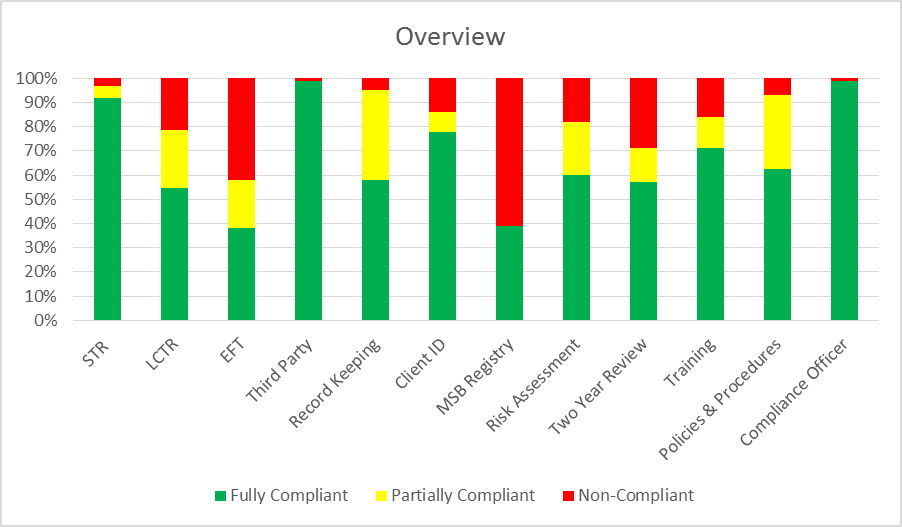
FINTRAC’s statistical analysis of MSB adherence to the requirements laid out in the Proceeds of Crime (Money Laundering) and Terrorist Financing Act (PCMLTFA) and its regulations is broken down by percentage, the results of the exams conducted that were fully compliant, partially compliant and non-compliant.  These are colour coded:

  • Green: fully compliant (no deficiencies were observed),
  • Yellow: partially compliant (there was something in place, but the MSB missed something), and
  • Red: non-compliant (in most cases, there was nothing in place or a reporting timeframe was missed).

Overall examination results have been positive.
Overview

It’s noteworthy that if FINTRAC has, as of 2014, found something during an examination that is considered ‘immaterial’, it’s not cited.  For example, in a large sample, if there are two client addresses that appear to be PO boxes, but all other client addresses were complete and in acceptable formats, there may not be a citation.  In these cases, FINTRAC may inform the RE verbally, but it will not be part of the formal ‘findings’ letter.

Compliance Officer

MSBs are required to have a Compliance Officer (a person that is responsible for overseeing the AML & ATF compliance program).  The appointment of the Compliance Officer must be documented in writing.  FINTRAC staff chided that this is likely the easiest area to achieve a fully compliant result in examinations.  MSB examination results certainly reflected this.

CO Chart

From a total of 612 MSB examinations considered, 608 MSBs were fully compliant.

Only four MSBs were deemed to be non-compliant.  It was noted that these were generally new market entrants that did not appear to understand Canadian AML & ATF compliance requirements.

Policies and Procedures

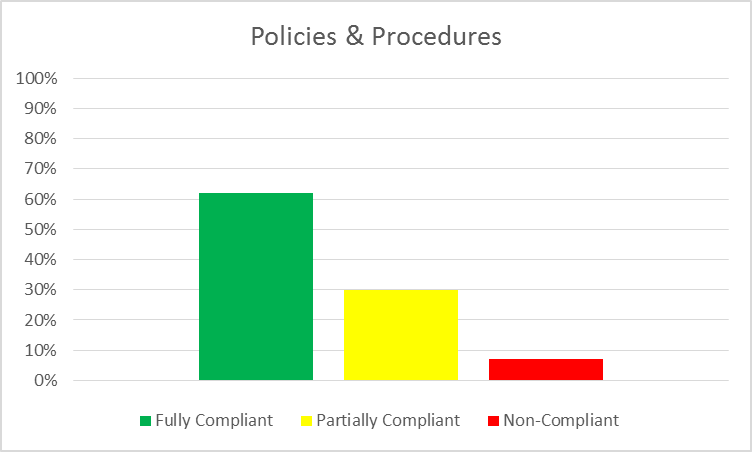
MSBs are required to have policies and procedures.  Policies describe the MSB’s regulatory obligations, while procedures describe what the MSB is doing to meet those requirements.  These must be documented, in writing, and the procedures must cover both staff and agents (if the MSB has agents).
PP Chart

From a total of 765 MSB examinations considered, 477 MSBs were fully compliant.

In 230 examinations, MSBs were deemed to be partially compliant.  Common errors included:

  • The omission of the 24-hour rule (specific descriptions of how the MSB determined whether or not reportable transactions had occurred over a 24 hour period),
  • Third party determinations (specific descriptions of when an MSB must determine if there is a third party involved, as well as what information needs to be collected and recorded), and
  • Politically exposed foreign person (PEFP) determinations (specific descriptions of when an MSB must determine if their client is a PEFP, and if so, what information needs to be collected/recorded. There is also a requirement that senior management signoff on the account within 30 days of the determination).

A total of 55 MSBs did not have any documented policies or procedures. In some cases, FINTRAC noted that there appeared to be processes in place, but that these were not documented in writing.

Training

MSBs are required to have an ongoing training program. The training program must be documented (who, what, where, when and how) and delivered to all staff and agents on an annual basis, at minimum.

Training Chart

From a total of 487 MSB examinations considered, 346 were fully compliant.

In 63 examinations, MSBs were deemed to be partially compliant.  Common errors included:

  • Interviews conducted with staff during an examination that evidenced a misunderstanding of the requirements (during an exam, FINTRAC will interview random staff members related to regulatory requirements to ensure training effectiveness)

In 78 examinations, MSBs did not have any training in place, or if they did, it was not documented.

Among the training options available to MSBs, we’re most excited about a relatively new offering from TAMLO that includes fast paced and visually stunning video content, as well as testing and tracking tools for Compliance Officers.

AML Compliance Effectiveness Review

MSBs are required to complete an AML Compliance Effectiveness Review once every two years.  The review must cover all policy and procedure documentation, as well as operational testing to ensure procedures are being properly followed.

2YR Chart

From a total of 722 MSB examinations considered, 412 were fully compliant.

In 101 examinations, MSBs were deemed to be partially compliant.  Where MSBs missed the mark was typically because they did not respect the two year cycle.  Other common errors included:

  • Only reviewing the policy documents with no operational testing of whether they are being followed (the policy document tells staff and agents what to do. Procedures tell them how to do it.  MSBs must be sure they are testing whether staff and agents are adhering to the procedures).

In 209 examinations, MSBs had not conducted an effectiveness review or could not provide evidence of one taking place.

Risk Assessment

MSBs are required to assess the risk that their business could be used for money laundering or terrorist financing.  The risk assessment must include four key components:

  • Products, services and delivery channels;
  • Geography;
  • Customers; and
  • Any other relevant factors.

Risk must be assessed and scored, and mitigated by appropriate controls.

RA Chart

From a total of 720 MSB examinations considered, 432 were fully compliant.

In 158 examinations, MSBs were deemed to be partially compliant.  The main issue was failing to include one of the four required elements. In some cases, a risk assessment was in place, but the documentation was not sufficient in assessing the MSB’s risk and controls.

In 129 examinations, MSBs had no evidence of a risk assessment.

FINTRAC noted that additional industry-specific risk assessment guidance is expected to be published later this year.

MSB Registration

MSBs are required to register with FINTRAC, as well as update their information within 30 days if there are any changes to business activities, banking or agent information.

MSB Reg Chart

From a total of 591 MSB examinations considered, 230 were fully compliant.

In this category, no partially compliant ratings were provided (the MSB registration was either complete, accurate and up to date, or it was deemed to be non-compliant).

In 361 examinations, MSBs were deemed to be non-compliant.  Most issues were due to a failure to update information when something within the business had changed or a failure to list all business activities. For example, the MSB registration may indicate that an MSB only performed foreign exchange in a case where remittance services were also provided.

Client Identification

MSBs are required to identify their clients in certain situations.  There are prescribed methods for completing this both in person and non-face-to-face (NF2F), and the identification document (ID) information must be recorded.

Client ID Chart

From a total of 796 MSB examinations considered, 621 were fully compliant.

In 64 examinations, MSBs were deemed to be partially compliant.  Common errors included:

  • Unacceptable ID (such as health card in Ontario);
  • Accepting ID that was expired at the time of the transaction (identification documents must be valid, or not expired, at the time they are reviewed);
  • Failing to record the prescribed details of the ID used (when reviewing a client’s ID, MSBs must keep a record of certain prescribed information); and
  • In Non-Face-To-Face Identification situations, only using one method, or using an unacceptable combination of methods (when identifying a customer who is not physically present, there are prescribed methods of how this is to be accomplished).

In 111 examinations, MSBs were non-compliant with client identification requirements.

Record Keeping

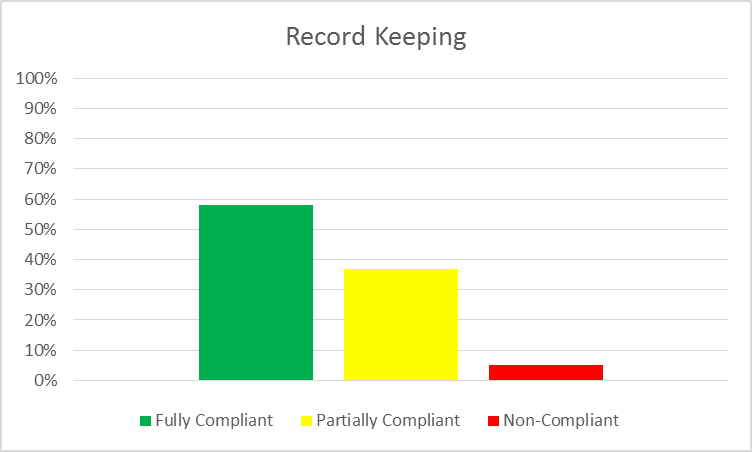
MSBs are required to keep certain records related to transactions and client identification.  These records must be stored in a manner that they can be accessed in the event they are requested, and must be maintained for at least five years.
RK Chart

From a total of 811 MSB examinations considered, 470 were fully compliant.

In 300 examinations MSBs were deemed to be partially compliant.  In these cases, record keeping was taking place but elements of the record keeping requirements were being overlooked.  Common issues included:

  • Missing telephone numbers;
  • Vague occupation information (for example “manager” or “worker”);
  • PO boxes recorded as customer addresses;
  • Missing postal codes;
  • Third party determinations that were incomplete; and
  • Payment methods for incoming and outgoing payments.

In 41 examinations, MSBs were non-compliant with record keeping requirements.

Third Party Determinations

MSBs are required to make a third party determination in certain prescribed circumstances, as well as collect and record certain information (name, address, date of birth, occupation and relationship to your client) about the third party.

TPD Chart

The total number of MSBs included in the review was not provided, with the statement: “there was not enough information available to conduct reasonable analysis”.  However, the total number of non-compliant MSBs was 6, indicating that approximately 600 MSB examinations were considered in this sample.

FINTRAC Reporting

When FINTRAC assesses reporting obligations, it uses the internal acronym “QTV”, which stands for quality, timing and volume.  Quality refers to the information in the report, specifically, if the report has all the required information.  Timing simply means, was the report filed within the designated timeframe.  Volume is slightly more complicated, but mainly refers to the amount of reports you have filed compared to your previous submissions.  It was noted that typically, where MSBs were deemed partially compliant, it was due to the quality.  Where non-compliance was related to the timing.

Electronic Fund Transfers Reports

MSBs are required to submit electronic funds transfer (EFT) reports to FINTRAC within 5 business days from the date the transaction took place.  An EFT includes the international transfer of CAD 10,000 or more, either in a single transaction, or multiple transactions within a 24-hour period.

EFT Chart

From a total of 434 MSB examinations considered, 165 were fully compliant.

In 87 examinations, MSBs were deemed to be partially compliant. MSBs were typically failing to include all required information, such as:

  • Phone number;
  • Date of birth; or
  • Postal code.

It is noteworthy that while not all fields are marked as required in F2R, all fields must be filled in if the MSB has recorded the information.

In 182 examinations, MSBs were deemed non-compliant, with most not reporting the EFTs within the specified time frame, and a small portion missing EFT reports.

Large Cash Transaction Reports

MSBs are required to submit large cash transaction (LCT) reports to FINTRAC within 15 calendar days from the date of the transaction, if the transaction was CAD 10,000 or more in cash, either in a single transaction, or multiple transactions within a 24-hour period.

LCTR Chart

From a total of 428 MSB examinations considered, 232 were fully compliant.

In 104 examinations, MSBs were deemed to be partially compliant.  MSBs were typically failing to include all required information, such as:

  • Occupation;
  • Date of birth;
  • Postal code; or
  • Type of ID used to identify the client.

In 92 examinations, MSBs were non-compliant, with most not reporting the LCTs within the specified time frame, and a small portion missing LCT reports.

Suspicious Transaction Reports

MSBs are required to submit suspicious transaction reports (STRs) and attempted suspicious transaction reports (ASTRs) to FINTRAC within 30 calendar days from the date the transaction is deemed suspicious by the Compliance Officer.

STR Chart

From a total of 285 MSB examinations considered, 262 were fully compliant.

In 14 examinations, MSBs were deemed to be partially compliant.  In these cases, MSBs were typically failing to include all required information.

In 9 examinations, MSBs were non-compliant.  Failing to file STRs carries relatively sever penalties, as the Canadian intelligence community relies on this type of reporting to build cases.  Where items are escalated as being potentially suspicious (either by staff or a transaction monitoring system), MSBs should always document the reason that these items are deemed not to be suspicious if no STR or ASTR reporting is completed.

Need a Hand?

If you are an MSB that needs compliance assistance (or a bank that wants assistance in setting up and maintaining a compliance regime that effectively manages MSB related risk), please contact us.


EFT Reporting Clarification – Field Limitations

Guest Blog

Our guest blogger this week is Jonathan Krumins, Vice-President, AML Risk & Compliance, at vCAMLO Solutions Inc. vCAMLO provides anti money laundering (AML) and anti-terrorist financing (ATF) support to Canadian credit unions. You can learn more about vCAMLO at www.vcamlo.ca.

Background

Over the past year, we have a noticed a change in how Electronic Fund Transfer Reports (EFTRs) are interpreted by the Financial Transactions and Reports Analysis Centre of Canada (FINTRAC).  For entities that are required to report EFTs, any amount valued at CAD 10,000 or more that is sent out of Canada or received from outside of Canada on behalf of a customer is reportable to FINTRAC within 5 business days. During recent exams, FINTRAC has been paying much closer attention to the details of each report, reviewing each field for missing or invalid information. Due to restrictions in how much information can be included in a report, an EFTR can be considered incomplete by FINTRAC, even if all information has been entered by the reporting entity.

Reports that are filed to FINTRAC electronically must meet FINTRAC’s batch reporting specifications, which includes character limits for each field in the report. For example, fields such as “Individual’s Occupation” or “Street Address” are limited to 30 characters. This presents two risks for reporting entities:

  • Descriptions that are longer than the field character limits, and
  • Limitations of third party software.

We have sought additional clarification about these scenarios, and how they may affect your FINTRAC reporting.

Information Longer than the Field Character Limit

Certain information, such as a foreign bank’s street address, can easily be longer than the 30 character limit. We recommend shortening the address as much as possible by using abbreviations, and by trying to ensure that only the bank’s civic address is included in the report.

For example:

If the complete address is: The Example Bank Building, 123 George Washington Street, P.O. Box 456 (69 characters with spaces), the address must be shortened to meet the field limits.

One option for shortening the address is: 123 George Washington St.

Limitations in Third Party Reporting Software

Some third party FINTRAC reporting software does not enforce a field cut off (and the end user may not be notified that some information was cut off). This can result in information that appears to be present in a report, but is actually cut off as it is sent to FINTRAC.

Using the same example, if only the first 30 characters are sent to FINTRAC, the address in the report would read: The Example Bank Building, 123.

Some third party reporting software provides a report “Preview” function, which can show you how the report will actually appear to FINTRAC. If this option is available, be sure to review the “Previewed” report to ensure that all necessary information is contained in the report, and that nothing is cut off.

If your third party reporting software has this limitation, we would recommend contacting the software provider to request that field limits be put in place to match FINTRAC’s reporting specifications.

Need a Hand?

vCAMLO: If you are a credit union or MSB, and have any questions related to EFTR, LCTR or STR reporting, or if you are interested in AML Support Services, please contact us for a complimentary 30 minute compliance discussion.

Outlier: If you need assistance reviewing your technology solution or FINTRAC reporting to be certain that you’re meeting the standard described in this blog, or just someone to chat with to make sure that you’re on the right track please contact us.

Full Text Response

Good afternoon Mr. Krumins,

Thank you for your follow-up inquiry.

As previously stated, the reporting entity is required to include the relevant information to identify the destination or sending institution. It is for the reporting entity to determine the relevant information as this is a question of fact.

For an international or foreign address, there is no specific formula since every country has its own conventions. If no numerical address exists, the reporting entity should take reasonable measures to include the relevant information to help identify the destination or sending institution. When the reporting entity is reporting non-SWIFT Electronic Funds Transfers, and the institution’s information exceeds the character capacity in the given address field, then the reporting entity should consider ways to abbreviate names or words, without deteriorating the quality of the information, as necessary.

Best Regards,

FINTRAC EFT Reporting Clarification

We’ve recently had quite a few conversations with our clients and friends about electronic fund transfer (EFT) reporting.

For entities that EFT 10Kare required to report EFTs, any amount valued at CAD 10,000 or more that is sent out of Canada or received from outside of Canada on behalf of a customer is reportable to the Financial Transactions and Reports Analysis Centre of Canada (FINTRAC) within 5 business days.  The question that keeps coming up relates to situations that have multiple senders or beneficiaries.

For example:

When Jaques (your customer in Canada) sends the equivalent of CAD 12,000 to his aunt Sally in Europe, this is clearly reportable as an EFT.

But

What if instead of sending the whole amount to his aunt Sally, Jacques instead send three transactions, each equivalent to CAD 4,000 to each of his nephews, Ralph, Jean and Morty?

After hearing different answers from different people, we thought it best to get a policy clarification from FINTRAC.  You can see the full text of that question, and FINTRAC’s answer below.

Outgoing EFTs With Multiple Beneficiaries Are Reportable

In the case that we mentioned above, Jacques’ transactions would be reportable EFTs, provided that all of the transactions happened within the same 24 hour period.  In this case, 3 reports would be sent, adding up to the total amount (which is over CAD 10,000).

Incoming EFTs From Multiple Senders Are Reportable

It stands to reason that if you receive multiple EFTs of behalf of the same beneficiary, the same rules would apply.

In the example above, for instance, let’s say that the money sent to Jacques’ nephews was a loan.  All of the nephews pay pack the loan at the same time, and you receive 3 EFTs for Jacques, each from a different sender, with a value of CAD 4,000 each (CAD 12,000 in total for the three EFTs).  These are also reportable, provided that the transactions all occurred within the same 24-hour period.

What Does It Mean If You’ve Interpreted the Reporting Requirements Differently?

In some cases, this may mean updates to your IT systems, to allow you to detect transactions that are received on behalf of the same beneficiary, or sent on behalf of the same sender.

It may also mean looking back at your transaction data, in order to figure out whether or not there are any EFTs that should have been reported to FINTRAC that were missed.  If this is the case, we recommend that you consider filing a voluntary disclosure with FINTRAC to proactively let them know about the issue, and what you’re doing to fix it.  If this is the case, we’ve created some free resources to help make this process as simple as possible.

Need a Hand?

If you’re not sure what to do next or you need extra hands to review your IT system updates or a package that you’re submitting to FINTRAC, please contact us.


Full Text of FINTRAC’s Response

Amber, 

     I am writing further to your e-mail of May 13, 2014, concerning how to report an electronic funds transfer sent by one client but to

multiple beneficiaries.

     As you know, pursuant to the /Proceeds of Crime (Money Laundering) and Terrorist Financing Regulations/ (PCMLTFR),  reporting entities are required to report to FINTRAC electronic funds transfers valued at $10,000 or more (in the course of a single transaction) at the request of a client, along with the information referred to in Schedule 2 or 5, as the case may be; and the receipt from outside Canada of electronic funds transfers, sent at the request of a client, of $10,000 or more in the course of a single transaction, along with the information referred to in Schedule 3 or 6, as the case may be.

     When a client requesting an EFT conducts a transaction with the initial amount of $10,000 or more and instructs that it be divided between multiple beneficiaries, the EFT is still being carried out by one client, and the EFT must be reported using multiple reports (one per beneficiary).  The key to determining the reporting requirement is the instruction given by the client. To better explain this, I have provided two examples below:

     1)  A client instructs that $15,000 be sent via EFT to different beneficiaries, $5000 each. In this instance, the reporting entity would be required to send three different reports, one for each beneficiary, for a total of the $15,000 that the client requested be sent via EFT. When submitting the reports, the 24-hour-rule indicator must be selected, although this is not considered to be a single transaction of $10,000 or more as defined under section 3 of the PCMLTFR.

     OR

     2)  A client instructs that $5000 be sent to beneficiary subsequent $5000 be sent to beneficiary B and a third $5000 be sent to beneficiary C. In this instance, the 24- hour rule must be considered.

The 24-hour rule applies if the reporting entity knows, or an employee or senior officer knows, that the transactions were made within 24 consecutive hours of each other, by or on behalf of the same individual or entity. It applies only to transactions that are under $10,000. If a transaction is for $10,000 or more, it is reportable as one transaction.  As such, if the reporting entity knows that the first two EFTs of $5000 each were made by, or on behalf of, the same person, then the reporting entity would be required to submit two reports under the 24-hour rule, as these two EFTs total $10,000.    

I trust this information will be of assistance.

Best regards

Return to Blog Listing