PROCESSING...

Anti-Money Laundering
Consulting Services & Strategies

0 Items - Total: $0.00 CAD

Is Your MSB Ready for a FINTRAC Exam?

Rodney_MSB2
We get a lot of questions about examinations conducted by the Financial Transactions and Reports Analysis Centre of Canada (FINTRAC). While we’re happy to be able to help our customers in their examinations (you can check out our free resources for FINTRAC exams here), the responsibility during the examination will rest with the money services business (MSB), mainly with the MSB’s Compliance Officer.

FINTRAC’s expectations have changed dramatically, since MSB’s were first required to comply with the Proceeds of Crime (Money Laundering) and Terrorist Financing Act (PCMLTFA) and its enacted regulations. In 2015, we noticed that there was a dramatic shift in focus of MSB examinations. FINTRAC’s examiners were much more interested in detailed procedures (documents that describe how MSBs are complying with the PCMLTFA and regulations), and the Risk Based Approach.

One of the most important things that MSBs can do to ensure that their AML compliance programs are up to date, and at the same time, prepare for FINTRAC examinations, is to read FINTRAC’s published guidance. Two important guidance topics published in 2015 are, the Risk-Based Approach Guide (this guide describes what is the risk-based approach) and the Risk-Based Approach Workbook for MSBs (this workbook is for MSBs looking to implement a risk-based approach). While guidance published by FINTRAC doesn’t carry the weight of law or regulation, it does provide valuable insight about FINTRAC’s expectations.

Another excellent source of information is FINTRAC’s published Policy Interpretations. These are FINTRAC’s official answers to questions asked by MSBs and other reporting entities.

In Person & Desk Examinations

Whether the FINTRAC exam is in person or desk (conducted by phone) examinations, they follow very similar formats. The key difference is the regulator’s ability to request additional operational data during onsite examinations.

It is ok for you to take notes throughout the examination process (and we recommend that you do). You are permitted to have a lawyer, consultant or other representative with you (if you do, FINTRAC will request that you complete the Authorized Representative Form in advance). While your representative cannot generally answer questions on your behalf, they can prompt you if you are nervous or stuck, and help you to understand what is being asked of you, if it is not clear.

If you do not speak English and/or French fluently, we highly recommend that you have a person present who can translate questions and responses for you.

If you are not certain what the examiner is asking for, you should always ask for clarification before answering.

For in person examinations, do not invite the examiner to have a pint, lunch or even a coffee. FINTRAC has very strict policies around bribery, to the extent that if I am out socially with an acquaintance who works for FINTRAC, I cannot pay for their tea. It may feel a little bit “over the top”, not to be able to extend these courtesies, but don’t be offended – it’s not you, it’s policy.

The Introduction

The examiner will provide a brief overview of the examination process as a formal opening to the examination. At the end of this introduction, the examiner will ask if you have any questions. At this point, it can be useful to provide a very brief (five minutes maximum) overview of your business.

Your introduction should reflect the materials that you have already submitted to FINTRAC (which ideally included an opening letter that described anything about the business that would not be readily apparent to the examiner, or anything that you believe could be misunderstood). Key facts about your business include:

  • Your corporate structure and ownership;
  • The types of products and services that are offered / types of transactions that are conducted;
  • Where your offices, agents and customers are located;
  • How you connect with and your customers; and
  • Anything significant that has changed since your last FINTRAC examination.

This synopsis must be very brief. If there is anything that is complex, it should be included as an explanation in your initial package (preferably in a simplified chart form – for example an ownership structure chart).

The examination will then begin. At the end of each section, the examiner will ask if you have any questions and let you know whether there are any deficiencies.

Part 1 – FINTRAC MSB Registration

In this part, FINTRAC will go through your MSB registration field by field and confirm that the information is accurate. The most common errors that we have seen are:

  • Not listing a trade name/operating name;
  • Not listing all relevant locations;
  • Listing bank accounts that are inactive or not listing bank accounts that are active;
  • Not including MSB or agent relationships (either buying from or selling to another MSB);
  • Incomplete ownership information; and
  • Senior Management and/or Compliance Officer information, that is out of date.

Although it is not technically part of the registration, some examiners will ask about the Compliance Officer’s responsibilities/duties at this stage.

Failure to update the MSB registration in the “prescribed form and manner” is the single most common deficiency for MSBs from 2008 to the present, accounting for deficiencies in 61% of examinations (according to FINTRAC data released in 2015).

Part 2 – Compliance Policies & Procedures

In this part, FINTRAC will ask questions about the policy and procedure documents that you have provided in advance of the examination. There are a few standard questions that are generally asked:

  • Who wrote the policies and procedures?
  • Were the versions submitted to FINTRAC the most recent versions?
  • When were they updated?
  • When and how do you identify your customers?
  • How do you ensure that identification is up to date?
  • How do you monitor transactions?
  • How do you recognize, document and monitor “business relationships” (note: this is any time that you have either an ongoing service agreement with a customer and/or your customer has performed two or more transactions that require identification).
  • What are indicators of a suspicious transaction?

The examiner will also ask a number of questions based on the documents that you have submitted, including questions about compliance-related processes.

Part 3 – Risk Assessment

In this part, FINTRAC will focus on your Risk Based Approach, asking specific questions about the Risk Assessment and related documents that you have provided in advance of your examination. Again, there are some common questions that are asked:

  • Do you have any high-risk customers or business relationships?
  • What factors do you consider in determining that a customer or business relationship is high risk?
  • How are customer due diligence and enhanced due diligence different (both generally, and in your processes and documentation)?

Most additional questions will be related to risk management processes. For example, it has been common in the last few months for examiners to ask if a customer or transaction could be rejected (“Yes, if it was outside of our risk tolerance.”)

This may also lead to questions about whether or not an Attempted Suspicious Transaction Report (ASTR) or Suspicious Transaction Report (STR) was filed. If there were reasonable grounds to suspect money laundering or terrorist financing, the answer should be yes, if not, you should explicitly say, “There were not reasonable grounds to believe that this event was related to money laundering or terrorist financing” then provide an explanation.

Part 4 – Operational Compliance & Reporting

In this part, the examiner will ask questions about specific transactions. Some of the cases that you must be ready to explain are:

  • A reportable transaction (generally an electronic funds transfer or EFT) was reported by another reporting entity;
  • A transaction matches an indicator of potentially suspicious activity (if there were reasonable grounds to suspect money laundering or terrorist financing, the answer should be yes, if not, you should explicitly say that “there were not reasonable grounds to believe that this event was related to money laundering or terrorist financing” then provide an explanation); and
  • Business relationships and ongoing monitoring (in particular, if this did not occur earlier in the examination).

During a desk examination, the examiners do not request additional materials.

During onsite examinations, it has become commonplace for examiners to request additional materials. These are generally related to:

  • Business relationships;
  • Ongoing monitoring (including the monitoring of business relationships),
  • High risk customers;
  • Enhanced due diligence; and
  • Other risk-based processes.

Be clear with the examiner about what can be extracted easily from your IT systems, and in the case that data cannot be extracted easily, be prepared to show the examiner an example (or several). If your system has an “auditor access” feature (generally read only access with search capability), it can be useful to set this up in advance of the onsite visit.

Exit Interview

Congratulations – you’ve made it to the finish line!

At this point, the examiner will sum up the findings (if there are any), and read a standard disclosure statement. For most of us, the disclosure statement is terrifying, as it talks about penalties. This is standard process – do not be alarmed. When the examiner has finished, you may ask if a penalty is being recommended (if you’re a worrier, please do this). Not all FINTRAC examiners will provide guidance at this stage, but it doesn’t hurt to ask.

The examiner will let you know when to expect a formal letter (generally within 30 days of the end of an examination).

After the Examination

You will receive a formal letter that details FINTRAC’s findings, as well as whether or not an Administrative Monetary penalty (AMP) is being recommended. In the case that there is a potential penalty, we recommend taking action as soon as possible). In most cases, FINTRAC does not require MSBs to submit an action plan (but your bank might still require that you do this, and it’s a good idea to keep a record of the actions that you’ve taken to correct any deficiencies).

Need a Hand?

If you are an MSB that needs compliance assistance preparing for an FINTRAC exam, remediating findings, or setting up an AML compliance program, please contact us.

Proposed PCMLTFR Updates

Screen Shot 2015-07-08 at 4.03.31 AM

We’ve created a marked-up version of the Proceeds of Crime (Money Laundering) and Terrorist Financing Regulations (PCMLTFR) that reflects the draft amendments posted in the Canada Gazette on July 4th, 2015.

Here’s a printable and downloadable PDF file: PCMLTFR Mark-Up (July 4, 2015 Draft Amendments)

If you would like a copy of the file in Microsoft Word, please contact us.

Need A Hand?

At Outlier, we believe that it is important to participate in decisions that affect you and your business.  If you would like someone to look over your submission before you make comments to the Department of Finance, you can get in touch with us free of charge.  We will look over your submission and make suggestions, without any cost to you.  If you need a hand, please feel free to contact us.

Unpublished FINTRAC Penalties

Jonathan Krumins, Vice President, vCAMLO

Today’s guest blogger is Jonathan Krumins, Vice-President, AML Risk & Compliance, at vCAMLO Solutions Inc. vCAMLO provides anti-money laundering (AML) and anti-terrorist financing (ATF) support to Canadian credit unions. You can learn more about vCAMLO at www.vcamlo.ca.

Background

Reporting entities (REs) often ask us about penalties, in particular when they are published publicly. Since 2009, The Financial Transactions and Reports Analysis Centre of Canada (FINTRAC) has issued Administrative Monetary Penalties (AMPs) against persons and entities that were found to have violated the Proceeds of Crime (Money Laundering) and Terrorist Financing Act, and its associated Regulations. In many cases up to 2013, FINTRAC has published details on its website about each penalty, including the name of the person or entity, the dollar amount of the AMP, as well as the cited deficiencies. The AMP area of their website has two sections – a list of all published penalties, as well as a running total of AMPs imposed since December 30, 2008, divided by sector.

As of June 26, 2013, FINTRAC changed its policy regarding public notice of AMPs, so that they would be published if one or more of the following criteria are met:

  • The person or entity has committed a very serious violation; or
  • The base penalty amount is equal to or greater than $250,000, before adjustments are made in consideration of the person or entity’s compliance history and ability to pay; or
  • Repeat significant non-compliance on the part of the person or entity.

AMPs can only be published once the appeals process is exhausted, which can take years to complete. This process can include an appeal to FINTRAC’s director, and a subsequent appeal to the Canadian Federal court.

Understanding this context is vital for RE Compliance Officers. While trend information related to published and unpublished penalties is not likely of interest to frontline staff, understanding these patterns is useful in fielding questions from Senior Management and the Board of Directors.

We have conducted an analysis of data published on the FINTRAC’s website which shows a trend of an increasing number of unpublished AMPs since 2013. These unpublished AMPs were primarily imposed on the Credit Union/Caisse Populaire and Money Service Business (MSB) sectors.

Methodology

We have made all calculations using information available as of April 20, 2015. We examined publicly available information on FINTRAC’s webpage, using the running total of AMPs by sector and the list of public AMPs. We also examined a summary of AMPs as of October 2014 obtained by Outlier through an Access to Information request. Our analysis focuses only on the sectors that have received AMPs, either published or unpublished: Credit Unions (including Caisses Populaires), MSBs, Real Estate Brokers, Securities Dealers and Casinos.

In addition, we accessed “cached” versions of FINTRAC’s website to review past versions in order to include six public AMPs that were issued between August 19, 2009 and April 26, 2010. In accordance with FINTRAC policy, these were removed from FINTRAC’s website after the five year public notice period had expired. We have included this historical data in order to provide a full view of the penalties issued. It is noteworthy that there are likely additional penalties in the process of being appealed (this information cannot be made available until the appeals process is complete).

Published AMPs vs. Unpublished AMPs

By analyzing the list of published penalties, compared to the running total of AMPs, it appears that there have been a significant number of unpublished penalties:

FINTRAC AMPs

Credit Unions

Credit Unions have received the largest number of unpublished penalties, both in terms of number and dollar amount. Credit unions have received 3 published AMPs, totalling $246,690. They have also received an additional 11 unpublished AMPs, totalling $405,855.

Trend analysis: This appears to be a significant increase in overall enforcement action by FINTRAC in the Credit Union sector. The total number of penalties against Credit Unions have increased sharply to 14, which means that Credit Unions now have the second largest number of listed AMPs (published and unpublished), behind MSBs. All penalties against Credit Unions since 2013 were unpublished. This data can also be interpreted to mean that FINTRAC’s enforcement efforts against Credit Unions have increased since 2013, however it is important to remember that AMPs are listed on FINTRAC’s website after they are finalized, which can mean a significant gap between when an AMP was issued and when it is listed, especially if there is an appeal involved.

Money Service Businesses (MSBs)

MSBs have received 22 published penalties, totalling $527,510. They also have received eight unpublished penalties, totalling $68,520. Interestingly, a $12,880 penalty that was published against an MSB on July 11, 2013 no longer appears on FINTRAC’s website.

Trend analysis: MSBs continue to be the leading sector in terms of receiving AMPs, although similar to the other sectors examined, the majority of AMPs that were against MSBs from late 2013 through to 2015 were unpublished.

Real Estate Brokers

Real Estate Brokers have received three published penalties totalling $40,520 compared to three unpublished penalties totalling $25,960.

Trend Analysis: Real Estate Brokers have received relatively few published and unpublished penalties in comparison to the Credit Union and MSB sectors. The number of unpublished penalties (compared to the number of published penalties) is consistent with trends across all sectors.

Securities Dealers

Securities Dealers have received four published penalties totalling $565,180 compared to one unpublished penalty of $21,480.

Trend Analysis: Securities Dealers have received relatively few published and unpublished penalties in comparison to the Credit Union and MSB sectors.

Casinos

Casinos have never received a published AMP, however FINTRAC’s website shows an unpublished AMP of $56,700 issued against a casino. This may be surprising to anyone that has read about BC Lottery Corporation, however, AMPs are not part of these records until the appeals process has been exhausted (and there have been successful appeals).

Trend analysis: It is difficult to establish a trend based on a single data point, however this unpublished AMP shows that the Casino sector is no longer unaffected by FINTRAC penalties.

What Does This All Mean?

Screen Shot 2015-05-06 at 11.58.01 AM

Note: The dates on the above graph represent when FINTRAC’s website was analyzed to calculate the total number of penalties, with the exception of October 2014, which is the “as of” date of an AMP listing received in a Freedom of Information request. Data for unpublished AMPs is only available since 2013.

As of June 2013, FINTRAC began to apply the updated standard for publicly listing AMPs. Since this change, unpublished penalties comprise approximately 42% of all issued AMPs by amount and 43% by number. While this is excellent news for REs that are concerned with the negative media and other reputational risk related to published penalties, it will make it more difficult to assess the reasons that REs are receiving penalties. The specific violations that led to a penalty are only made public by FINTRAC when the AMP is published. In order to ensure that our Credit Union clients are well-informed about industry trends related to penalties, vCAMLO will be requesting additional information and performing trend analysis. Stay tuned!

Your Best Defence

To avoid AMPs, it is essential to constantly test for weaknesses in your compliance regime. Conduct rigorous effectiveness testing (this is required at least every two years), and consider more frequent testing. Finally, ensure that immediate steps are taken to remediate deficiencies received in FINTRAC exams. Deficiencies that re-appear in follow-up exams are taken seriously by FINTRAC, and can lead to penalties, published or not.

Need a Hand?

vCAMLO: If you are a credit union or MSB, and have any questions related to financial compliance, or if you are interested in AML Support Services, please contact us for a complimentary 30 minute compliance discussion.

Outlier: If you need assistance reviewing your technology solution or FINTRAC reporting to be certain that you’re meeting the standard described in this blog, or just someone to chat with to make sure that you’re on the right track, please contact us.


Suspicious Transaction Reporting in 2015

Preparing for a FINTRAC examination

At the Canadian Institute’s 14th Annual AML Forum, the Financial Transactions and Reports Analysis Centre of Canada (FINTRAC) reviewed its expectations for suspicious transaction reporting. FINTRAC emphasized that suspicious transaction reports (STRs) are vital to the agency’s mandate as Canada’s financial intelligence unit (FIU) and ongoing collaboration with law enforcement agencies. While reporting entities (REs) in Canada have been required to report transactions for quite a few years, we’ve had many questions from REs about what FINTRAC expects and looks for in examinations. FINTRAC’s most recent guidance is useful in tuning your technology, enhancing your processes, and asking the right questions at industry association meetings.

What is FINTRAC Looking for in STRs?

When FINTRAC conducts compliance examinations, they will be applying three tests to STR data, including:

  1. Entity Practitioner: FINTRAC will look for transactions that are similar to those involved in STRs that you have reported. If there are similar transactions or transaction patterns that have not been reported to FINTRAC, there should be an explanation for the difference. Where possible, this explanation should be documented.
  2. Sector Practitioner: FINTRAC will compare the number and type of STRs submitted by similar entities. The size and type of business are taken into consideration.
  3. Reasonable Practitioner: FINTRAC will analyze a sample of reported STRs and unreported transactions against relevant guidance. In this case, relevant guidance means the suspicious transaction indicators from FINTRAC’s Guideline 2 that are applicable to your business.

These are terms that we’re likely to hear more about over the coming months, and there are compliance program adjustments (most of them relatively simple) that can be made to ensure that you’re meeting this standard.

Tune Your Technology

Amber looking at laptop FINTRAC screen

Most REs use software solutions to detect potentially suspicious transactions. Almost all transaction monitoring software uses some type of rules-based system to determine when alerts should be generated. These rules should, at minimum, reflect the indicators that are applicable to your business. Not all of the indicators from FINTRAC’s Guideline 2 will be applicable to your business. Where possible, you should document the decisions that you make about your transaction monitoring rules, including the rationale for those decisions.

The most sophisticated software platforms have machine learning functions. These can take the decisions that have been made about previous alerts and use this information to refine how the program works. For example, if a particular pattern of transactions was deemed to be suspicious, the program may look for similar patterns.

If you’re not using software that does this on its own, don’t panic. You can review the STRs that you’ve submitted to FINTRAC to determine whether your transaction monitoring rules are tuned to reflect the types of money laundering and terrorist financing threats that you’ve previously encountered. This should be done on a regular basis (for example, as part of your Risk Assessment updates). If you have an STR that is related to a pattern that you don’t have a rule to cover, you may want to do this sooner, rather than waiting for the next scheduled update.

Train Your Staff

Training

Over the years, I’ve heard many Compliance Officers express frustration about not knowing whether or not STR data has been useful to FINTRAC or law enforcement. To close this gap, I’ve looked for articles and speakers from FINTRAC and law enforcement that could provide meaningful information about the type of information that is most useful. The same principle applies to your staff.

You can use existing cases (you’ll want to remove any personal information for training purposes) to demonstrate the type of transactions that you want your staff to escalate to compliance for review. Existing cases from the media, and end to end cases provided by training companies like TAMLO, are also excellent resources. Keeping your annual training fresh is a challenge, and using your STRs as cases is one way to do that, while also meeting FINTRAC’s expectations.

Refine Your Audits & Effectiveness Reviews

AML Compliance Effectiveness Review

Are your auditors and/or reviewers using the same tests that FINTRAC is using to assess your compliance? If you’re not certain, ask.

If you perform self-assessment testing, you may want to include these tests as well.

As of 2015, all AML Compliance Effectiveness Reviews performed by Outlier will use these three key tests to assess STR data.

Ask Your Industry & Working Groups for More

Hanshake

Most REs have excellent industry associations and working groups such as the Canadian Banker’s Association (CBA), Canadian MSB Association (CMSBA) or the Canadian Jewellers Association (CJA). These groups are excellent resources and can help you understand STR trends across your industry. If you’re not a member, you may still be able to attend regular conferences or events.

Need A Hand?

We would love to hear from you. If there are topics that you would like to know more about, or if you need assistance with your compliance program, please contact us.

FINTRAC Examination Results for MSBs

The Canadian Money Services Business Association (CMSBA) recently held their Spring Training events in Montreal, Vancouver and Toronto.  The list of speakers included MSB industry professionals, as well as representatives from regulators including the Financial Transactions and Reports Analysis Centre of Canada (FINTRAC).  For a full synopsis of the Montreal and Toronto events, click here.  FINTRAC presented excellent statistical data about how MSBs have fared in examinations conducted between April 2011 and July 2014.  So how are MSBs faring?  Very well overall. 

ZDE FINTRAC 2008-2013

Data obtained through a freedom of information request indicates that almost 25% of MSBs examined between 2008 and 2013 have not had any deficiencies.

How Does FINTRAC Decide Who Is Examined?

FINTRAC considers several factors when deciding which reporting entities (REs) will be examined.

  • Concurrent Examinations: examinations conducted in tandem with the Office of the Superintendent of Financial Institutions (OSFI). This is applicable to federally regulated financial entities (FRFEs) like banks.
  • Market Share: The largest reporting entities in Canada (because the larger an organization is, the more critical the risk of non-compliance will be);
  • Cyclical: Coverage of a whole industry (this seemed to apply most to Casinos).
  • Follow-Up: Subsequent examinations based, with an emphasis on the resolution of deficiencies found in previous examination(s) to ensure remediation. FINTRAC noted that although it is no longer a requirement to submit a formal action plan to FINTRAC, it is a best practice for REs to document (and update) an action plan internally.
  • Risk: FINTRAC’s evaluation of the RE’s risk, based on a broad selection criteria, such as money laundering and terrorist financing vulnerabilities, the likelihood of non-compliance and industry trends.
  • Theme-Based: Related to specific intelligence about a RE or type of business that indicates there may be an elevated risk of non-compliance, money laundering vulnerability or terrorist financing vulnerability.

Methodology & Analysis

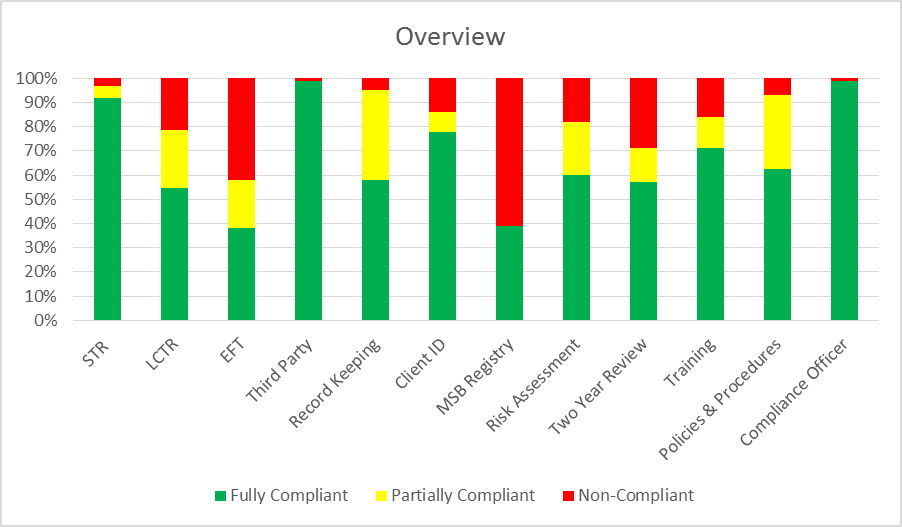
FINTRAC’s statistical analysis of MSB adherence to the requirements laid out in the Proceeds of Crime (Money Laundering) and Terrorist Financing Act (PCMLTFA) and its regulations is broken down by percentage, the results of the exams conducted that were fully compliant, partially compliant and non-compliant.  These are colour coded:

  • Green: fully compliant (no deficiencies were observed),
  • Yellow: partially compliant (there was something in place, but the MSB missed something), and
  • Red: non-compliant (in most cases, there was nothing in place or a reporting timeframe was missed).

Overall examination results have been positive.

Overview

It’s noteworthy that if FINTRAC has, as of 2014, found something during an examination that is considered ‘immaterial’, it’s not cited.  For example, in a large sample, if there are two client addresses that appear to be PO boxes, but all other client addresses were complete and in acceptable formats, there may not be a citation.  In these cases, FINTRAC may inform the RE verbally, but it will not be part of the formal ‘findings’ letter.

Compliance Officer

MSBs are required to have a Compliance Officer (a person that is responsible for overseeing the AML & ATF compliance program).  The appointment of the Compliance Officer must be documented in writing.  FINTRAC staff chided that this is likely the easiest area to achieve a fully compliant result in examinations.  MSB examination results certainly reflected this.

CO Chart

From a total of 612 MSB examinations considered, 608 MSBs were fully compliant.

Only four MSBs were deemed to be non-compliant.  It was noted that these were generally new market entrants that did not appear to understand Canadian AML & ATF compliance requirements.

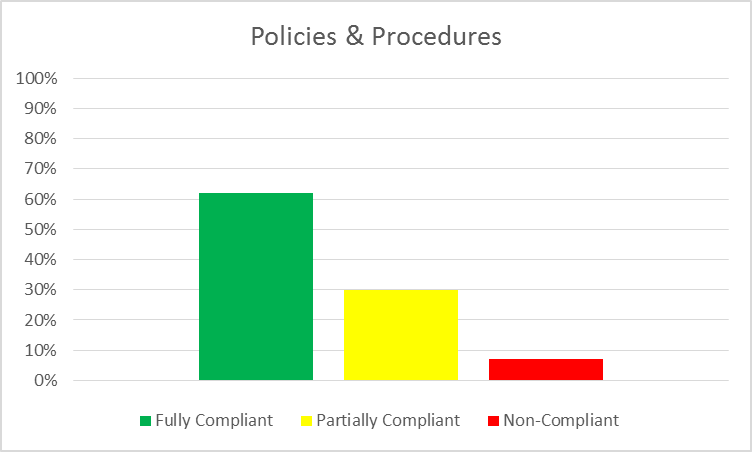
Policies and Procedures

MSBs are required to have policies and procedures.  Policies describe the MSB’s regulatory obligations, while procedures describe what the MSB is doing to meet those requirements.  These must be documented, in writing, and the procedures must cover both staff and agents (if the MSB has agents).

PP Chart

From a total of 765 MSB examinations considered, 477 MSBs were fully compliant.

In 230 examinations, MSBs were deemed to be partially compliant.  Common errors included:

  • The omission of the 24-hour rule (specific descriptions of how the MSB determined whether or not reportable transactions had occurred over a 24 hour period),
  • Third party determinations (specific descriptions of when an MSB must determine if there is a third party involved, as well as what information needs to be collected and recorded), and
  • Politically exposed foreign person (PEFP) determinations (specific descriptions of when an MSB must determine if their client is a PEFP, and if so, what information needs to be collected/recorded. There is also a requirement that senior management signoff on the account within 30 days of the determination).

A total of 55 MSBs did not have any documented policies or procedures. In some cases, FINTRAC noted that there appeared to be processes in place, but that these were not documented in writing.

Training

MSBs are required to have an ongoing training program. The training program must be documented (who, what, where, when and how) and delivered to all staff and agents on an annual basis, at minimum.

Training Chart

From a total of 487 MSB examinations considered, 346 were fully compliant.

In 63 examinations, MSBs were deemed to be partially compliant.  Common errors included:

  • Interviews conducted with staff during an examination that evidenced a misunderstanding of the requirements (during an exam, FINTRAC will interview random staff members related to regulatory requirements to ensure training effectiveness)

In 78 examinations, MSBs did not have any training in place, or if they did, it was not documented.

Among the training options available to MSBs, we’re most excited about a relatively new offering from TAMLO that includes fast paced and visually stunning video content, as well as testing and tracking tools for Compliance Officers.

AML Compliance Effectiveness Review

MSBs are required to complete an AML Compliance Effectiveness Review once every two years.  The review must cover all policy and procedure documentation, as well as operational testing to ensure procedures are being properly followed.

2YR Chart

From a total of 722 MSB examinations considered, 412 were fully compliant.

In 101 examinations, MSBs were deemed to be partially compliant.  Where MSBs missed the mark was typically because they did not respect the two year cycle.  Other common errors included:

  • Only reviewing the policy documents with no operational testing of whether they are being followed (the policy document tells staff and agents what to do. Procedures tell them how to do it.  MSBs must be sure they are testing whether staff and agents are adhering to the procedures).

In 209 examinations, MSBs had not conducted an effectiveness review or could not provide evidence of one taking place.

Risk Assessment

MSBs are required to assess the risk that their business could be used for money laundering or terrorist financing.  The risk assessment must include four key components:

  • Products, services and delivery channels;
  • Geography;
  • Customers; and
  • Any other relevant factors.

Risk must be assessed and scored, and mitigated by appropriate controls.

RA Chart

From a total of 720 MSB examinations considered, 432 were fully compliant.

In 158 examinations, MSBs were deemed to be partially compliant.  The main issue was failing to include one of the four required elements. In some cases, a risk assessment was in place, but the documentation was not sufficient in assessing the MSB’s risk and controls.

In 129 examinations, MSBs had no evidence of a risk assessment.

FINTRAC noted that additional industry-specific risk assessment guidance is expected to be published later this year.

MSB Registration

MSBs are required to register with FINTRAC, as well as update their information within 30 days if there are any changes to business activities, banking or agent information.

MSB Reg Chart

From a total of 591 MSB examinations considered, 230 were fully compliant.

In this category, no partially compliant ratings were provided (the MSB registration was either complete, accurate and up to date, or it was deemed to be non-compliant).

In 361 examinations, MSBs were deemed to be non-compliant.  Most issues were due to a failure to update information when something within the business had changed or a failure to list all business activities. For example, the MSB registration may indicate that an MSB only performed foreign exchange in a case where remittance services were also provided.

Client Identification

MSBs are required to identify their clients in certain situations.  There are prescribed methods for completing this both in person and non-face-to-face (NF2F), and the identification document (ID) information must be recorded.

Client ID Chart

From a total of 796 MSB examinations considered, 621 were fully compliant.

In 64 examinations, MSBs were deemed to be partially compliant.  Common errors included:

  • Unacceptable ID (such as health card in Ontario);
  • Accepting ID that was expired at the time of the transaction (identification documents must be valid, or not expired, at the time they are reviewed);
  • Failing to record the prescribed details of the ID used (when reviewing a client’s ID, MSBs must keep a record of certain prescribed information); and
  • In Non-Face-To-Face Identification situations, only using one method, or using an unacceptable combination of methods (when identifying a customer who is not physically present, there are prescribed methods of how this is to be accomplished).

In 111 examinations, MSBs were non-compliant with client identification requirements.

Record Keeping

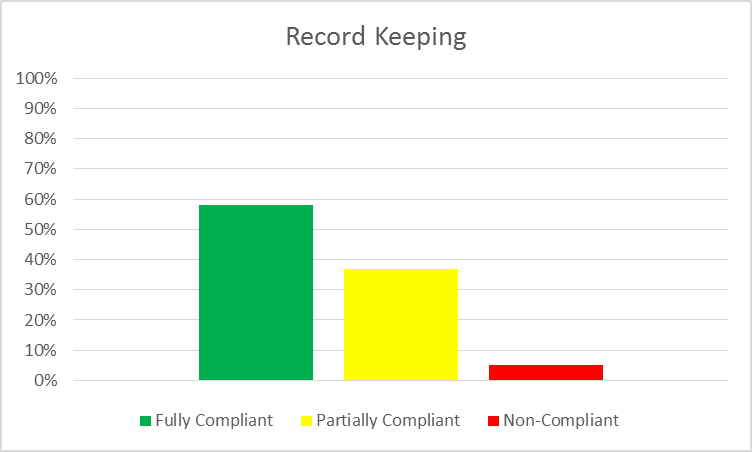
MSBs are required to keep certain records related to transactions and client identification.  These records must be stored in a manner that they can be accessed in the event they are requested, and must be maintained for at least five years.

RK Chart

From a total of 811 MSB examinations considered, 470 were fully compliant.

In 300 examinations MSBs were deemed to be partially compliant.  In these cases, record keeping was taking place but elements of the record keeping requirements were being overlooked.  Common issues included:

  • Missing telephone numbers;
  • Vague occupation information (for example “manager” or “worker”);
  • PO boxes recorded as customer addresses;
  • Missing postal codes;
  • Third party determinations that were incomplete; and
  • Payment methods for incoming and outgoing payments.

In 41 examinations, MSBs were non-compliant with record keeping requirements.

Third Party Determinations

MSBs are required to make a third party determination in certain prescribed circumstances, as well as collect and record certain information (name, address, date of birth, occupation and relationship to your client) about the third party.

TPD Chart

The total number of MSBs included in the review was not provided, with the statement: “there was not enough information available to conduct reasonable analysis”.  However, the total number of non-compliant MSBs was 6, indicating that approximately 600 MSB examinations were considered in this sample.

FINTRAC Reporting

When FINTRAC assesses reporting obligations, it uses the internal acronym “QTV”, which stands for quality, timing and volume.  Quality refers to the information in the report, specifically, if the report has all the required information.  Timing simply means, was the report filed within the designated timeframe.  Volume is slightly more complicated, but mainly refers to the amount of reports you have filed compared to your previous submissions.  It was noted that typically, where MSBs were deemed partially compliant, it was due to the quality.  Where non-compliance was related to the timing.

Electronic Fund Transfers Reports

MSBs are required to submit electronic funds transfer (EFT) reports to FINTRAC within 5 business days from the date the transaction took place.  An EFT includes the international transfer of CAD 10,000 or more, either in a single transaction, or multiple transactions within a 24-hour period.

EFT Chart

From a total of 434 MSB examinations considered, 165 were fully compliant.

In 87 examinations, MSBs were deemed to be partially compliant. MSBs were typically failing to include all required information, such as:

  • Phone number;
  • Date of birth; or
  • Postal code.

It is noteworthy that while not all fields are marked as required in F2R, all fields must be filled in if the MSB has recorded the information.

In 182 examinations, MSBs were deemed non-compliant, with most not reporting the EFTs within the specified time frame, and a small portion missing EFT reports.

Large Cash Transaction Reports

MSBs are required to submit large cash transaction (LCT) reports to FINTRAC within 15 calendar days from the date of the transaction, if the transaction was CAD 10,000 or more in cash, either in a single transaction, or multiple transactions within a 24-hour period.

LCTR Chart

From a total of 428 MSB examinations considered, 232 were fully compliant.

In 104 examinations, MSBs were deemed to be partially compliant.  MSBs were typically failing to include all required information, such as:

  • Occupation;
  • Date of birth;
  • Postal code; or
  • Type of ID used to identify the client.

In 92 examinations, MSBs were non-compliant, with most not reporting the LCTs within the specified time frame, and a small portion missing LCT reports.

Suspicious Transaction Reports

MSBs are required to submit suspicious transaction reports (STRs) and attempted suspicious transaction reports (ASTRs) to FINTRAC within 30 calendar days from the date the transaction is deemed suspicious by the Compliance Officer.

STR Chart

From a total of 285 MSB examinations considered, 262 were fully compliant.

In 14 examinations, MSBs were deemed to be partially compliant.  In these cases, MSBs were typically failing to include all required information.

In 9 examinations, MSBs were non-compliant.  Failing to file STRs carries relatively sever penalties, as the Canadian intelligence community relies on this type of reporting to build cases.  Where items are escalated as being potentially suspicious (either by staff or a transaction monitoring system), MSBs should always document the reason that these items are deemed not to be suspicious if no STR or ASTR reporting is completed.

Need a Hand?

If you are an MSB that needs compliance assistance (or a bank that wants assistance in setting up and maintaining a compliance regime that effectively manages MSB related risk), please contact us.


Insights From the CMSBA Education Days

We were fortunate enough to be able to attend the Canadian MSB Association (CMSBA)’s Montreal and Toronto spring training days. For Money Services Businesses (and those affiliated with the industry), the CMSBA is an excellent resource for collaboration, information sharing and advocacy. For those that were not able to attend any of the spring training sessions, here’s a roundup of the topics covered.

FINTRAC & MSB Compliance Examinations

Canada’s federal regulator for anti-money laundering (AML), the Financial Transactions and Reports Analysis Centre of Canada (FINTRAC), provided in depth statistics related to compliance examinations, as well as common issues for MSBs. Despite what some highly publicized administrative monetary penalties (AMPs) may lead you to believe, MSBs are faring well as a sector in FINTRAC’s compliance examinations. It’s noteworthy that through a freedom of information request, Outlier obtained data on the number of MSBs that did not have any deficiencies in examinations. Between 2008 and the end of 2014, this amounted to approximately 25% of all MSBs examined. In most cases, MSBs were largely compliant, with some partial deficiencies.

Overview Big

For a complete breakdown of common issues noted in examinations, click here.

AMF, Respondents & Digital Currency

Québec’s provincial regulator, the Autorité des Marchés Financiers (AMF), provided clarification on its expectations for MSB respondents. For MSBs dealing with customers in Québec that do not have offices in the province, a respondent must be nominated to deal with the AMF on the MSB’s behalf. Among the requirements are that the respondent must:

  • Be over 18 years old;
  • Have an address in Québec (home address or business address); and
  • Not be under tutorship, curatorship or advisorship.

The AMF also addressed digital currency, noting that not all digital currency business models are covered by the Québec MSB Act, and that there must be an element of fiat currency involved in the transactions. Both the AMF’s press release from February 2015 and the current presentation confirmed that digital currency trading platforms (that include fiat currency transactions) and digital currency ATMs are considered in scope. As there are a myriad of other digital currency related business models, if you are unsure of where you fit, you can contact the AMF and receive a decision (we recommend that you request a decision in writing where possible).

Agency Agreements

I had the honour of speaking about MSB agency agreements (the agreements between MSBs and their agents) with Susan Han (previously of AUM Law). Like most things, agent agreements should be documented in writing and clearly spell out the terms of the agreement. MSBs that take on agents should understand that the MSB would bear most of the risk (financial, compliance and reputational). Agents should be aware that the client (and information about the client) “belongs” to the MSB rather than the agent (and this information should always be provided to the MSB when it is requested).

International Collaboration & De-Risking

The CMSBA has partnered with MSB associations worldwide to increase awareness of the negative ways in which de-risking (which CMSBA Director Ken Saul noted should be called de-banking) affects the financial system. As the de-risking issue has affected MSBs worldwide, and there does not appear to be any effective solutions under consideration, a whitepaper was developed and presented to the Financial Action Task Force (FATF). This whitepaper has received a positive reception. Stay tuned for more on the international efforts in this regard.

One of the few Canadian Financial Institutions that (openly) banks MSBs, Luminus Financial, was on hand to discuss factors that MSBs should consider when dealing with banking relationships. MSBs should be prepared to provide complete and transparent information about their business. In order to achieve success in both obtaining and maintaining banking relationships, MSBs should be able to demonstrate that they are compliant and present information in a way that is well organized and addresses all of the questions and requests that the bank has made. In some cases, this will be a higher standard than simply meeting the minimum compliance requirements set out in law and regulation.

Compliance Maturity Model

In looking proactively at issues related to de-risking and demonstrating compliance, the CMSBA is working to develop a compliance maturity model (CMM). Currently, CMSBA members can complete the first stage of this model by completing an attestation form online. The attestation states that the MSB is compliant with applicable legislation and not subject to administrative or criminal proceedings. Questions, comments or suggestions related to the CMM can be directed to cmsba-cmm@canadianmsb.org.

Need a Hand?

If you are an MSB that needs compliance assistance (or a bank that wants assistance in setting up and maintaining a compliance regime that effectively manages MSB related risk), please contact us.


Micro Deposits & Micro Withdrawals

The Big DisclaimerAmber looking at laptop blank screen

We’re not lawyers and nothing that we write should be considered a legal opinion. Whether or not a solution will be acceptable to your regulators will always depend on your implementation and documentation – please contact us if you need help with either.

Background

There are a limited number of ways for Canadian reporting entities to identify individuals without meeting face to face. Previously, we have sought opinions from the Financial Transactions and Reports Analysis Centre of Canada (FINTRAC) on whether or not micro deposits and micro withdrawals could be used to confirm a customer’s identity. Until recently, the answer had been no. We reached out to FINTRAC again on the issue after learning that technology had evolved in a way that could meet the requirements. We’re pleased to share with you that FINTRAC is of the opinion that – given the right technology conditions – micro deposits and micro withdrawals can indeed be used to confirm a customer’s identity.

Confirmation Of A Deposit Account

The methods that can be used to confirm a customer’s identity are listed in Schedule 7 of the Proceeds of Crime (Money Laundering) and Terrorist Financing Regulations (PCMLTFR). (Since this post was written, Schedule 7 has been repealed and replaced by FINTRAC’s Methods to Identify Individuals). The “Confirmation of a Deposit Account Method” involves confirming that the person has a deposit account (this means a chequing or savings type of account) with a Canadian financial entity (this means a bank, credit union or caisse populaire). To use this method, reporting entities must keep a record of the name of the financial entity where the account is held, the account number and the date of the confirmation.

The key elements of this method involve determining that the account belongs to the person that you are trying to identify and determining that the account is indeed a chequing or savings type of account.

Micro Deposits and Micro Withdrawals

Previously, micro deposits and micro withdrawals were viewed as failing on both of these key elements. Confirming the amount of a micro transaction proved that a person had access to the account, but not that they owned the account. It was also viewed as impossible to determine the type of account (for instance the account may have been a line of credit that had a similar account number structure).

Fortunately, technology has advanced and some payment processors are able to conduct name matching (in some cases, payments are even stopped if there isn’t a match) as well as the type of account. Not all payment processors may have the capabilities, but if you’re looking for a way to automate some of your non face-to-face customer identification, this could be an option.

Implementation Checklist

We’ve broken down the implementation into seven key questions. If you’re able to answer yes in each case, you’re likely to be ready to implement micro deposits or micro withdrawals as an identification method.

  1. Does my payment processor conduct name matching (our client’s name against the account being debited or credited) and what confirmation do we receive of a match?
  2. Is our system set up to keep a record that demonstrates that the name was matched?
  3. Does my payment processor have access to the account type when an account is being debited or credited and can they pass that information to us and/or confirm for us that the account is a deposit account?
  4. Is our system set up to keep a record of the type of account or confirmation that the account is a deposit account?
  5. Is our system set up to keep a record of the name of the financial entity where the account is held?
  6. Is our system set up to keep a record of the account number?
  7. Is our system set up to keep a record of the date of the confirmation?

In addition to this list, you should also give some thought to what happens when identification fails (for example if the name doesn’t match or the account isn’t the right type). You’ll need to consider an alternative way to identify your client, and you probably don’t want their account stuck in limbo.

Need a Hand?

If you want to be certain that you’re meeting the standard described in this blog, or just someone to chat with to make sure that you’re on the right track please contact us.

Full Text Response

Good afternoon Ms. Scott,

Thank you for contacting the Financial Transactions and Reports Analysis Centre of Canada (FINTRAC), Canada’s independent agency responsible for the collection, analysis, assessment and disclosure of information in order to assist in the detection, prevention, and deterrence of money laundering and financing of terrorist activities in Canada and abroad.

You indicated, “some payment providers have the capacity to match the customer’s name to the name on the account (and will not process transactions if there is not a match) and return information about the type of account to which the transaction was pushed.”

In light of this, you have asked whether micro-withdrawals and/or micro-deposits would be acceptable for use as confirmation of a deposit account provided that:

(a) there was a confirmed name match; and

(b) the account type was confirmed as a deposit account.

Subparagraph 64(1)(b)(ii) of the Proceeds of Crime (Money Laundering) and Terrorist Financing Regulations (PCMLTFR) states that non-face-to-face identification can be done by using a combination of identification methods as set out in Part A of Schedule 7, the confirmation of deposit account method being one. This method of ascertaining a person’s identity consists of confirming that the person has a deposit account with a financial entity, other than an account referred to in section 62 of the PCMLTFR. For the deposit account method, paragraph 67(c) of the PCMLTFR requires that the client name, the deposit account number, the financial entity name, and the date of the confirmation be recorded. Therefore, if the payment provider confirms the client name, the deposit account number, the financial entity name, and the date of the confirmation, then yes, the micro-withdrawals and/or micro-deposits is an acceptable means to confirm a deposit account with a financial entity as per Part A of Schedule 7 of the PCMLTFR, and would satisfy one of the two combination methods required.

Please note that FINTRAC does not endorse nor advertise any products, companies, or providers of consumer information.

I trust this information will be of assistance.

Canadian Digital Currency Regulation

BitcoinAcceptedHereLate last week, Canadian Bill C-31 received royal assent (meaning that it has been approved and will become Canadian law).  The bill covered many areas, one of which was anti money laundering (AML) and anti-terrorist financing (ATF) requirements for Canadian businesses.  This included adding “dealers in digital currency” to the definition of money services businesses (MSBs).

It’s not yet clear when these changes will come into force, but we expect that there will be a period of at least six months before businesses need to be compliant.   You can read the final version of the bill here. In the mean time, we expect to see a consultation paper and draft regulations before final regulations are released.  The law will not come into effect until final regulations are released, and the regulations will clarify exactly what dealers in digital currency need to do to comply.

For businesses that operate in Canada or have Canadian customers (customers that are served in Canada – including via the web), this will mean registering with government agencies as an MSB, maintaining an AML and ATF compliance program, being compliant with the laws (which includes keeping records and identifying customers and reporting certain types of transactions), answering to the regulators and disclosing certain information to financial service providers.

Who Is a Dealer In Digital Currency?

Bill C-31 did not define dealers in digital currency.  Instead, the bill states that the definition will be included in the Proceeds of Crime (Money Laundering) and Terrorist Financing Regulations (Regulations).  Generally speaking, being a dealer in any type of good or service implies that you are selling something for profit.  The proposed definition is likely to appear in the initial consultation paper (expected this summer) as well as the draft version of the regulations.

It’s important to note that if you are dealing in digital currency today, but not engaging in any other MSB activities, you’re still not considered an MSB and you don’t have compliance obligations (yet).

MSB Registration

Dealers in digital currency will need to register as MSBs.  Anyone dealing with customers in Canada will need to register as an MSB with the Financial Transactions and Reports Analysis Centre of Canada (FINTRAC).  The process involves contacting FINTRAC to provide initial information and gaining access to the MSB registration site.  There will be a number of questions about the owners of the business, senior officers, banking relationships and projected revenues.  While the process is not costly, it can take time (in particular if the regulator requires clarification).

MSBs serving customers in the province of Quebec are also required to be licensed with the Authorite des Marches Financiers (AMF).  Licensing related fees range from about CAD 607 to CAD 2428, excluding additional fees of CAD 202 per automated teller machine (ATM) operated in Quebec.  You can learn more about the Quebec licensing process here.

Dealers in digital currency will not be able to register as MSBs at this time, but should expect to do so once the final regulations have been issued.  The registration processes can take time, and it’s useful for businesses to start the process as early as possible in order to avoid being off side with the law.

Compliance Programs

AML and ATF Compliance Programs generally have five elements:

  • A Compliance Officer (the person who oversees compliance for the organization),
  • Policies and Procedures (documents that describe what you’re doing to comply),
  • A Risk Assessment (a document that describes the risk that your business could be used to launder money or finance terrorism, and the controls that you have in place to prevent this from happening),
  • Training (this is delivered at least annually to all staff that deal with customers or transactions), and
  • Effectiveness Reviews (like an audit for compliance, these are completed at least every two years).

Some dealers in digital currency may already have voluntary compliance programs in place.  These programs will most likely need to be updated when the final regulations are published.

Operational Compliance

In addition to having a documented AML & ATF compliance program, there are certain things that MSBs need to do in order to comply with the law.  Currently, these include identifying customers when the MSB:

  • receives the equivalent of CAD 10,000 or more in cash,
  • sells or cashes $3,000 or more of traveller’s cheques, money orders, or anything similar instruments,
  • exchanges currency of $3,000 or more for another currency,
  • sends or receives international money transfers of $1,000 or more, and/or
  • suspects that a transaction, or an attempted transaction, of any amount, is related to a money laundering offence or a terrorist financing offence.

Identification in this case is tightly defined as either the MSB or it’s representative looking at an original, valid (not expired) piece of government issued identification in person (via Skype or webcam doesn’t count) or using specific methods described in the Regulations.

MSBs are also required to keep specific types of records for at least five years, including customer and transactions records.  All records must be stored in such a way that they can be quickly retrieved if the regulator requires them (generally within 30 days of the date that the regulator makes the request).  In addition, MSBs are required to report certain transactions to FINTRAC and other agencies within set timeframes.

Like having a compliance program in place, these requirements don’t apply to dealers in digital currency yet, but it’s helpful for business owners to start thinking about the types of changes that may need to be made to IT systems and processes once regulations are released.

Penalties

The penalties for non-compliance can be significant, and may include either civil penalties, criminal penalties or both.  For instance, failure to report suspicious transactions can result in penalties up to CAD 2 million and/or 5 years imprisonment.

In addition, FINTRAC may publish penalties on its website.  While monetary penalties can be substantial, it is the publication of these penalties that can ultimately be more damaging to businesses.  Few banks or other financial service providers are willing to work with organizations that have published violations for non-compliance.

What’s Next For You?

If your business is likely to be considered a dealer in digital currencies, you will have an opportunity later this year to comment on the consultation papers and draft regulations.  It is unlikely that the sector will remain unregulated in Canada for long, but you will have an opportunity to voice your opinion about the proposed changes.

In the mean time, it’s time to start thinking about what you’ll need to do in order to be compliant.  Who will your Compliance Officer be?  What changes will you need to make to your documents, systems and processes?  Although there are certain things that you won’t be able to do quite yet, you can organize your resources to be ready later this year.

If you’re concerned about the next steps and need a hand, please feel free to contact us anytime.  Conversation are always free, and if you choose to hire us for a project, we do accept payment in bitcoin.

Outlier BTC Tipping AddressTipping QR Code

I’m a Compliance Officer! Now What?!?

Compliance Officer

I’ve met a lot of Compliance Officers from around the world, and not one of them has ever told me that as a child they wanted to be a Compliance Officer.  This isn’t to say that the job isn’t interesting (or even an awful lot of fun sometimes), but that we get here in different ways.  One of my favourites (who will remain nameless here) is a gentleman who missed a senior management meeting and was nominated as the organization’s Compliance Officer while he was absent.  When we first met, he was feeling overwhelmed and was looking for a review of his company’s compliance program (and assurances that he wouldn’t wind up in an orange jumpsuit if he made a mistake).

While it seems like an extreme case, many Compliance Officer’s feel this way at least once during their careers.  It’s a big responsibility that doesn’t often come with the budget to match.  Whether you’re new to the world of anti-money laundering (AML) or just looking for a quick “sanity check” to make sure that things are going the way that they should be, this “cheat sheet” is for you.

Your Compliance Program

You need to have a Compliance Program in place with these 5 elements:

  1. Appoint A Compliance Officer (hey that’s you!);
  2. Document Your Policies And Procedures;
  3. A Risk Assessment;
  4. Training; and
  5. An AML Compliance Effectiveness Review.

If your organization is a money service business (MSB) you will also need to register with the Financial Transactions and Reports Analysis Centre of Canada (FINTRAC).  If your organization is an MSB operating in Quebec, you also need to register with the Autorité des marchés financiers (AMF).  The definition of an MSB in Quebec is a bit broader than the Canadian federal definition; some companies may only be required to register with the AMF.

The first thing that you should do is review your documentation to make sure that it’s up to date.  Here’s a quick checklist to get you started – answer each of the questions with ‘Yes’ or ‘No’.

Program Component

Questions You Should Ask

Compliance Officer Is my appointment documented? This can be in the form of meeting minutes or a formal document, but it must be in writing.
Policies and Procedures Do they describe what we’re doing to meet our obligations? The descriptions should be clearly written so that someone that doesn’t know your business could understand them.
Have they been updated in the last year?
Risk Assessment Does the Risk Assessment describe the risk that your business could be used for money laundering or terrorist financing?
Are there risk ratings?
Are your controls (what you do to prevent your business from being used for money laundering or terrorist financing) describe?
Do your controls make sense given your risk level?
Training Have your staff been trained in the last year?
Does your training cover all of the obligations that apply to your business?
AML Compliance Effectiveness Review Has an AML Compliance Effectiveness Review been completed in the last two years?
Was there a formal report that described the methodology and findings?
Did management sign-off on the final report within 30 days?

If you answered yes to all of these questions, you’re off to a good start.  If the answer to any of these questions is no, you have some work to do.  If that’s the case, consider letting your management team know right away.  It’s easier to get their support when they know what you’re working on.

FINTRAC Reporting

Other than terrorist property reports, FINTRAC reports can be filed electronically using a system called F2R.  If your organization is not already using this system, you can enroll by contacting FINTRAC.  Filing your reporting electronically can make it easier to keep track of the reports that you’ve filed (remember to save copies of the PDF reports on your network) and let you know more quickly whether or not FINTRAC has accepted your reports.

FINTRAC has published guides to help you with your reporting.  Each report type in the chart is hyperlinked to FINTRAC’s guidance.  The types of reports that you will submit will depend on the type of reporting entity you belong to.  However, all reports have set time limits.

Report Type

Timing

Suspicious Transaction Reports (STRs) and Attempted Suspicious Transaction Reports (ASTRs) As soon as practicable
Large Cash Transaction Reports (LCTRs) 15 calendar days from the date that the transaction takes place
Electronic Funds Transfer Reports (EFTRs) 5 working days from the date that the transaction takes place
Large Virtual Currency Transaction Reports (LVCRTs) 5 working days from the date that the transaction takes place
Casino Disbursement Reports (CDRs) 15 calendar days from the date that the transaction takes place
Terrorist Property Reports (TPRs) As soon as possible (Immediately)

Training Your Staff

All staff should be trained at least once a year (including part-time, temporary and contract staff).  Your training records should include:

  • Who was trained?
  • When did training take place?
  • How was training delivered (in person, webinar, etc…)
  • What topics were covered?

This can be done in a simple spreadsheet.  You don’t need to collect signatures to prove that training took place, but you do need to be sure that your records are accurate.

There are very few instances when staff members do not need to be trained.  Generally, these would be staff members that are not involved in any way with customers or customer transactions.  If there are staff members that are not trained, you should document who they are, their roles, and the reason that they are exempt from training.

AML Compliance Effectiveness Reviews & FINTRAC Exams

I’ve put together some detailed guidance on preparing for reviews and exams.  It’s important to remember to get all of your documentation in order in advance.  Make sure that you’ve read the request and understand what you are being asked for.  If you have questions about what you should include, it’s fine to call the reviewer or examiner to ask.

Information requests are time-sensitive.  For FINTRAC exams, you generally have 30 days from the date that the request was mailed to assemble your submission.  This seems like a long time, but you may need some extra help pulling everything together.  It’s a good idea to let your management team know as soon as you receive a request from the regulator, especially if you need extra resources to stay on top of the request and everyday compliance tasks.

Need a Hand?

If you’re feeling like your AML program needs work, and you’re not sure what to do next or you need extra hands to put together or look over your FINTRAC package, please contact us.

Return to Blog Listing